
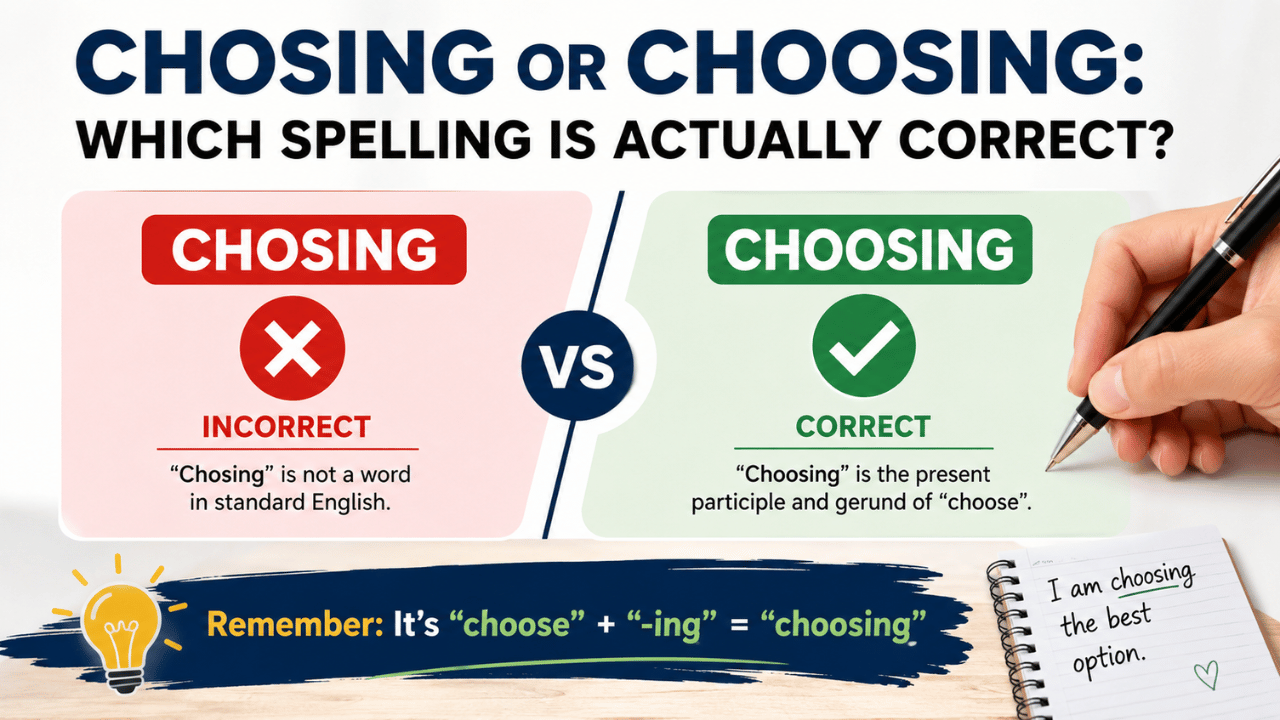
If you have ever written a sentence and stopped midway, wondering whether it should be “chosing” or “choosing”, you are one of us – English’s slipperiest spelling missteps. This is something that happens to everyone, from native speakers to language students, usually because the word simply looks wrong no matter how you spell it. Fortunately, this is one of those spelling questions with a very straightforward answer.
In this post, we finally definitively answer the chosing or choosing question, tell you precisely why one spelling is right, and show you some easy techniques you can use to remember which version is correct.
The Quick Answer
“Choosing” is the correct spelling. Its the present participle and gerund of the verb ‘choose’, as in “Art means choosing between two things” or, “Choosing which path to take is important”. For starters, the word “Chosing” itself: it isn’t a recognised word in English according to any dictionary that anybody cares about – let alone anything like Scrabble – it is simply a spelling mistake in every context, from text message abbreviations and spoken notation all the way up to academic writing.
This means that the chosing or choosing question will never come up when you are writing, as there is no regional variant or alternative form to take into consideration. You want “choosing,” every time.
Why Is This Mistake Committed So Frequently?
One way to understand why “chosing” feels correct to you is actually to look at how “-ing” verbs usually form in English. Commonly for all verbs ending in an unpronounced sound, the general rule is to drop the last “e” preceding “-ing.” Consider “make” to make “making”, “write” to write “writing”, or “hope” to hope “hoping”. By the same reasoning, “choose” would lose its e and become choos, which is precisely why so many people are now mindlessly defaulting to that spelling without giving it a second thought.
The issue is that the way that “choose” is constructed does not follow the idea of pattern succinctly defined by people. “Choose” ends as “choo-se,” with a pair of double-o’s stuck together, right up until the moment you drop the final “e,” leaving you with “chose,” which is already legitimate English and, in fact, the simple past tense of “choose”: “she chose.” In fact, “chosen” has a separate dictionary entry, and therefore is its own word because just attaching -ing to it for “chosing” would create an actual confusion with the forms of the past participle and present participle.
This is one problem English resolves by allowing a full double “o” spelling in “choosing,” so the past tense form (“chose”) can be clearly differentiated. This is really the core of the chosing or choosing dilemma: the general silent-e-dropping rule nearly seems to apply here, but not entirely, because “choose” & “chose” are already so similar.
Where Does “Choose” Come From?
“Choose” comes from the Old English “ceosan,” which goes back to a family of words found in early Germanic languages referring to probing, tasting, or selecting. The modern spelling they finally agreed on was “choose,” with its double O that has remained fairly stable through to the present, more than half a millennium later.
In fact, this stability is important for the spelling of words such as “choose,” “chooses,” “chose,” “chosen” and “choosing” because it means each different form has its own distinctive spelling so that you would never confuse one form with another if they began to resemble each other. Using a full double “o” in “choosing” is also an example of having similar but different word forms look visually distinct.
Also Read: 6 7 Meaning | WYO Meaning Slang | RD Meaning in Text
Understanding the Full Verb Conjugation
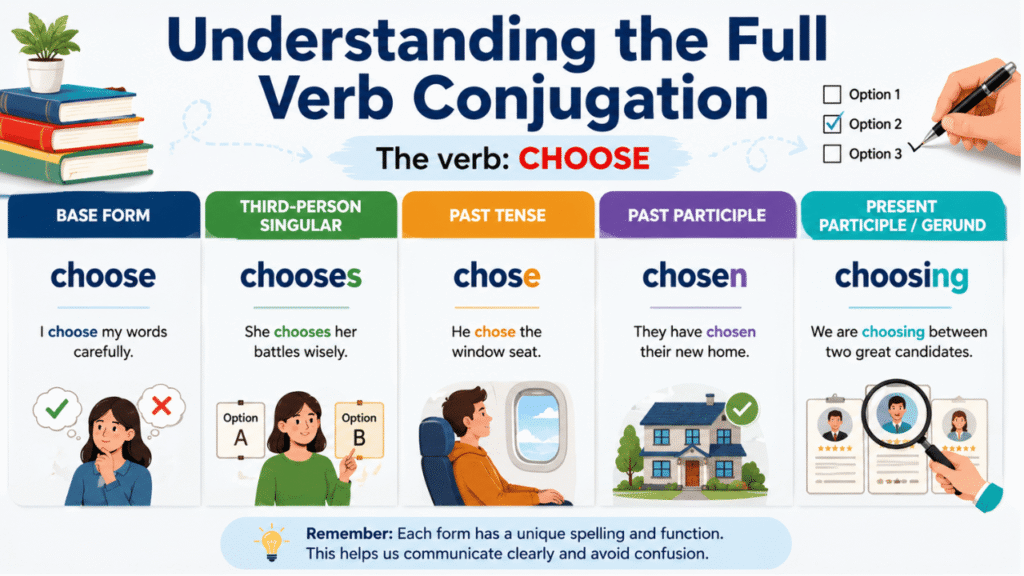
Regular verbs form the past tense by adding -ed to the root, but become irregular when working with them, using an even less predictable pattern that does not follow a simple and objective conjugation like “choose”. The full picture alone can make the correct spelling of “choosing” feel more natural.
- Base form: choose (I choose my words carefully.)
- Third-person singular: chooses (She chooses her battles wisely.)
- Past tense: chose (He chose the window seat.)
- Past participle: chosen (They have chosen their new home.)
- Present participle/gerund: choosing (We are choosing between two great candidates.)
Look how next to each other in this list sit “chose ” and “choosing” regarding the grammatical part they both stand for: a completed activity in the past vs. ongoing/continuous action, or it would be a name-like gerund. Spelling “choosing” with the full double “o” ensures that readers can immediately recognize which form they are reading, rather than trying to rely solely on context clues to decipher which choice is meant.
How “Choosing” Is Actually Used
Grammatically “choosing” serves two very common roles in everyday English.
In the present participle form, with a form of “to be”:
As a present participle, paired with a form of “to be”:
- I’m choosing a new laptop this weekend.
- She’s choosing between two job offers.
- They were choosing paint colors for the nursery all afternoon.
As a gerund, functioning like a noun:
- Choosing the right college is a big decision.
- Choosing kindness, even when it’s difficult, says a lot about someone’s character.
- Her choosing to speak up took real courage.
In either case the present ongoing act of “choosing” which can be read as happening now in other words or generally or even an abstract discussion on the decision to select between options.
Is “Chosing” Ever Correct?
In regular modern English, no; not recognizable. “Chosing” is nowhere to be found as an alternate spelling or informal variant in the big dictionaries, such as Merriam-Webster, Oxford, or Cambridge. However, it is not a regional variant either, as the words commonly have some genuine differences between British and American English spelling, as in “colour” vs. “color.” Now this is a whole new kettle of fish; “chosing” is just plain simply treated as an incorrect spelling, end.
You might see it now and then in informal writing, unpolished works, fast text messages or social media posts (where typographical errors go unnoticed), but never in formal professional writing.
Common Mistakes People Make
This exception to the silent-e-dropping rule stuns a lot of writers because most English verbs make that rule feel automatic. Below are some scenarios in which the error is likely to show up most frequently:
Too broad generalizing of the common rule. When you learn that the -e ending in words such as make becomes making and write becomes writing, it is a logical if incorrect jump to think choose must follow this same rule.
Confusing “chose” and “choosing” mentally. Because chose is already off a word “chose,” with the e dropped, some writers incorrectly build chosing off that word instead of from choose.
Second glance fast typing It happens, much like many other minor spelling errors when we write fast, message or make quick notes without reviewing.
Inconsistent autocorrect behavior. This is caught fairly regularly by some spell-checkers, while others, depending on the platform or settings, might fail to flag the error all the time and let it slip through.
An irregular verb like this will never work, and a quick proofreading pass can help catch it before it makes its way into the finished product.
How to Remember the Correct Spelling
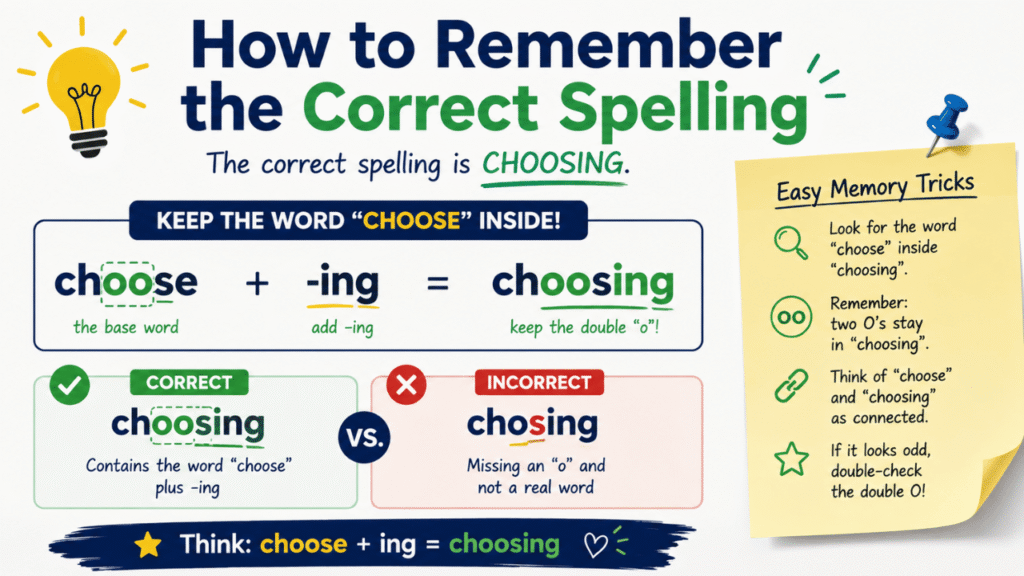
Here is an easier memory aid to permanently cement “choosing”: Imagine the entire word “choose” right inside of “choosing,” with only “-ing” tacked onto the end, no letters missing or unischedded. You automatically wrote the first half of that sentence because “choose” already has you trained with the unique double “o” – reminding yourself that “choosing” just preserves that double o will make it feel much more natural to spell it correctly.
Another good way to do that is to leave the “choosing” vocabulary out of your mind entirely next to “chose”. Thinking of them as two visually distinct words, one with a double “o” and one without, reinforces the exact reason why “chosing,” grammatically, does not fit into what you might expect.
Why Getting This Right Matters
And while this might be a minor quibble, “choosing” is one of the most overused words in writing, appearing nearly every day in everything from essays to email and Twitter posts to theses. Forget spelling, but choosing, which is worse than all if this were clean writing, hateful-spoke rewritten.
Being consistent and accurate strengthens the trust that readers have in your writing. A typo here and there is usually forgiven, but if any word as common as “choosing” appears over and over again misspelled in a piece of writing, it can silently seduce away the reader’s belief that this writer has their act together.
Also Read: PMO Meaning in Text | ALR Meaning in Text | FML Meaning
Conclusion
The chosing or choosing debate has a straightforward answer, and it is a certain one: “choosing” is the correct word, while “chosing” does not exist at all in standard English. It derives from the fact that, for this verb, the usual e-dropping rule would almost apply to choose – but then again, English retains both o’s in the double-o spelling (in order not to confuse with its past tense form, chose).
Once you see this logic and link “choosing” to the root meaning of the word, which is now a base form (i.e., called “chose,” not a short-scale modification), this will become something that you seldom need to question again as far as spelling.
FAQs About Chosing or Choosing
1. Why not just drop the “e” on choose before “-ing”?
“Selecting,” in the final round, retains its double “o” when entering into “choosing”, sparing you the confusion caused by “chose,” i.e., choose’s past tense.
2. What is the difference between chose and choosing?
Past tense is “chose,” while present participle “choosing” describes an action in the process of occurring.
3. Is “chosing” a British or American English spell?
No. Chosing is wrong in British and American English.
4. How many forms are there for “choose”?
The forms are: choose, chooses, chose, chosen, and choosing.
5. Is there any trick for remembering the spelling?
Simply add -ing on choose without removing anything like “choosing.”