
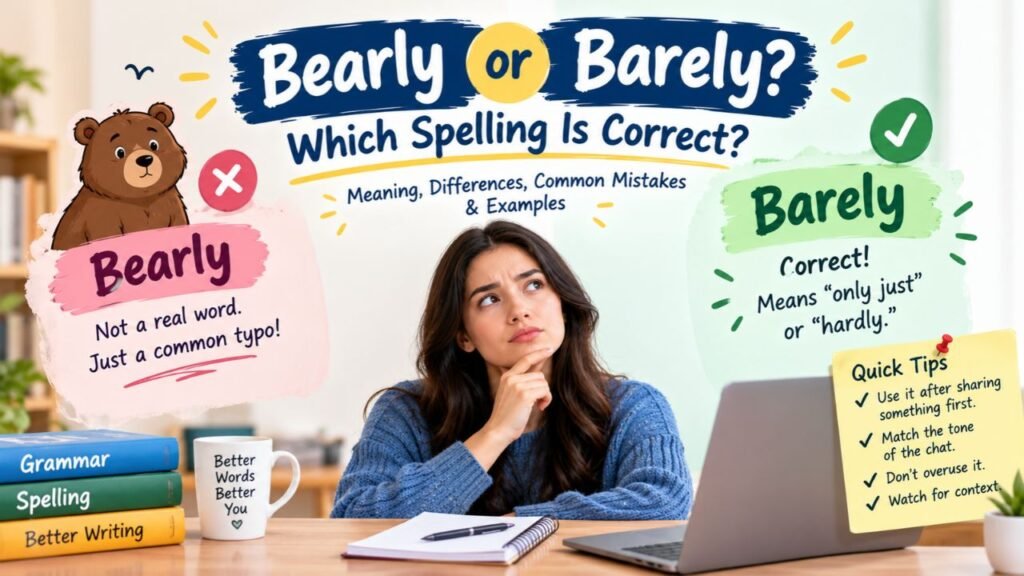





So you might start typing a string as “I could _ keep my eyes open”, but by the word blank, your fingers froze. You know the one with the animal spelling or that ending that adds an extra “r”? The bearly or barely question fools quite a few self-confident writers, but it’s really the way English has lots of sibling/twin words built out of the same sounds. In this article, we go over how to spell which is correct, why that mistake occurs, and the best way to avoid it all of the time.
The Quick Answer
“Barely” is correct. As an adverb, it means “only just” or “hardly.” Bearly is not an English word and is not found in dictionaries. If it appears in writing, it’s a typo probably related to the word “bear.”
Whenever you see bearly or barely in a sentence, choose “barely.” Whether it be an email, essay, or story abstract, title, or even formal reports, it works.
| Spelling | Status | Example |
| Barely | Correct | “She barely made it to the station on time.” |
| Bearly | Incorrect | “She bearly made it to the station on time.” |
What “Barely” Means
The term “barely” is an adverb. It means an event occurring by the narrowest of margins. This can also refer to something that is barely acceptable, or just.
Here are the main senses.
Only just. “He barely passed the exam.” So he passed, but just barely.
Hardly or scarcely. The speaker was almost inaudible. This also meant listening was a significant challenge.
Just recently. As soon as they got there, it started to rain. This explains why the second activity occurred rather quickly after the first.
Almost not at all. “She barely noticed the noise.” Which implies the effect is tiny.
In any case, the term indicates a narrow margin. Hence why it pops up so often in everyday conversation – from talking about narrowly avoiding a collision to alleviating some tiredness.
Where “Barely” Comes From
The word “barely” is constructed from the adjective bare plus the adverb suffix -ly. The word has its roots in the Old English barren, meaning so completely bare, barren, or empty, which evolved to the lesser-in-sense “nothing but basic.” The nakedness, the non-shape, like a “bare minimum” or “a bare room.” Which gave way to the idea that “barely” means no raindrops left, equivalent to nothing.
This origin explains the spelling. The “a” in “bare” is followed by an “r” and a silent “e,” causing it to get absorbed into the word since “barely” comes from that. The “e” drops before the familiar “-ly” for many English words. None of this history has anything to do with the animal “bear,” and so the spelling “bearly” is devoid of any basis.
Why People Write “Bearly”
The confusion between bearly or barely comes with some habitual causes.
They sound identical. “Bare” and “bear” are homophones, which means they share the same pronunciation. The wrong spelling, however, easily it starts to slip through when we write from sound only.
Bear is a word that we are probably more familiar with. The animal and the verb “to bear” are encountered by many more people than the adjective “bare,” so it feels natural to reach for that spelling.
Spell-checkers can miss it. Some tools highlight “bearly” as a mistake, but others replace it with strange alternatives or not at all in some cases, so the error may slip through to published writing.
Typing quickly. Adding or dropping a letter on a phone is almost effortless, and even the most minor typo can resemble an entirely different word.
Also Read: Chosing or Choosing | Gaslighting Meaning | WYO Meaning Slang
Bare vs Bear: The Root of the Problem
It becomes much simpler to determine which spelling, bearly or barely, when you understand the two source words.
| Word | Part of Speech | Meaning | Example |
| Bare | Adjective / verb | Uncovered, minimal, to expose | “The walls were bare.” |
| Bear | Noun / verb | The animal; to carry or endure | “I can’t bear the noise.” |
That “barely” comes from the first column, not the second. The other thing to know is that if you can link “barely” and “bare,” which means “minimal,” you’re going to always have the correct spelling.
Common Phrases Using “Barely”
Visualisation of the word in common phrases helps you start to feel at home with working out how that word is spelled correctly.
- “Barely there” describes something almost invisible or tiny.
- “Barely scraped by” means managing with the smallest margin.
- “Barely alive” describes someone exhausted or in poor shape.
- “Barely noticeable” means hard to detect.
- “Barely enough” means just sufficient.
- “Can barely wait” is a lively way to express excitement.
- “Barely a word” means almost nothing was said.
All of these use “barely” to express a minuscule value. None of these would be spelled with “bear.”
Barely vs Hardly vs Scarcely
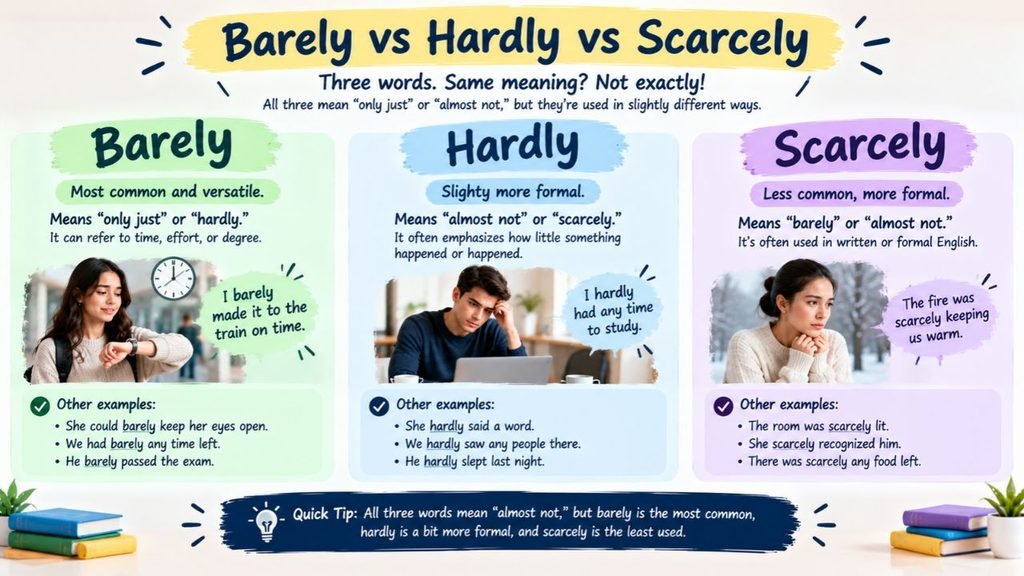
There is some overlap between these three words, and knowing the distinctions between them may help hone your writing.
Barely more than means that something was almost too close to happen. “He barely finished on time.”
Often with the adverb hardly, meaning you can rarely but also so rarely that you would be surprised if it happened at all. “I hardly know her.”
Scarcely is a more formal synonym of sorts. “There was scarcely a sound.”
They’re often interchangeable, but the feel is a little different. In terms of bearly or barely then keep in mind that anything other than “barely” isn’t a word, they are just alternatives and not variants of the same spelling.
Barely in Everyday Sentences
Understanding a word within its context is crucial to solidifying the correct spelling. These are just some instances from around the world.
- At work. “The team barely met the deadline, but the client was happy.” This describes a close finish.
- At home. “I barely slept last night because of the storm.” This is a terribly small unit of sleep.
- At school. “He barely passed the test after studying for only an hour.”
- In sport. “The runner barely held on to first place in the final stretch.”
- In conversation. We barely know each other, but it feels like we’ve been friends for years.”
In each use of the word, it points to a close margin. Every time you spot that feeling of “only just: you need to spell it as ‘barely. The bearly or barely choice never changes, whether you are teaching in a classroom.
How Writers and Editors Identify This Mistake
Spell-check is not enough, and professional editors rarely use it as their only source of truth. They are trained by relying on a few habits to catch mistakes like this.
Read aloud, then read slowly. Since bare and bear are pronounced the same, there will be no realization of error when reading it out loud. To read it less quickly, word after word.
Search the document. Within a long document: Finding “bearly” takes seconds and finds every instance of the word. Good for a final sanity check of an article before publishing.
Check homophones deliberately. Editors remember pairs of homophones, such as bare and bear, using that list to stop silently talking whenever they hear one of those sounds.
Ask whether the word is real. If you ever get confused about bearly or barely, a quick dictionary search indicates that there is only one of these words.
These habits only take around 10 seconds each, and they work for many other challenging pairs likewise.
Punctuation and Word Order With “Barely”
I thought it might be useful to touch on a small grammar point. When it starts a sentence (for emphasis) “barely” will often put the verb before the subject. She had just sat down when the telephone rang. This is an inverted structure which sounds primarily in writing, especially formal or literary.
At the simple words order, “barely” is often with particulars to be before the verb: “She cancelled barely noticed. It is also possible for it to come after an auxiliary verb: She had hardly noticed. Both versions are correct, and it has only one way of spelling.
Common Mistakes to Avoid
Other than the bearly or barely issue, there are a couple more common mistakes that pop up time and again.
- Writing “bearly” in any context. This is main error what this guide will cover.
- Writing “barley” by accident. Barley is actually a word, it’s one of those grains that you can make beer out of, not an adverb.
- Using a double negative. I can barely hear you is the standard construction, and “barely” has an inherent negative sense. Instead say “I can hardly hear you”.
- Confusing it with “barely” as a place name. Some surnames or places use unusual spellings, but they don’t change the standard word.
The “barley” error is particularly pernicious because it passes spell-check as a correct word. Barley in a sentence if someone is hearing anything about running, walking or finishing on time.
An Easy Mnemonic to Recall the Spelling
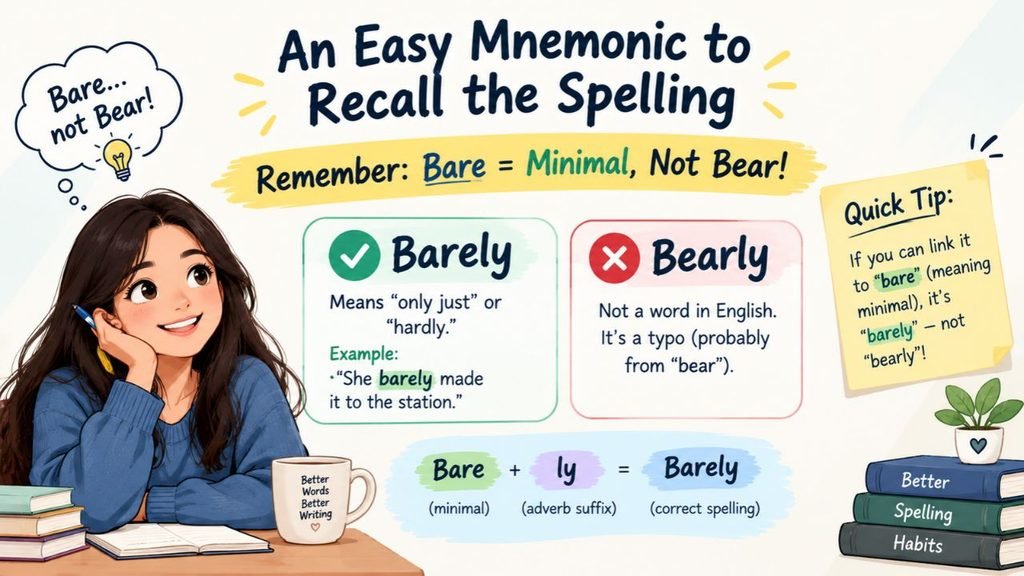
Try this memory trick. Now consider “barely” and think of it as “bare” + “ly.” If you can imagine a room without anything in it, or almost nothing, that is what “barely” feels like. Both come from the same root.
Alternatively, you could remember by realizing that bears are animals and not found in this word. “Bea” is not how you spell it if you’re talking about a creature or the verb to carry.
Why Getting It Right Matters
Small, spell-check types of errors can undermine solid writing. If you spot the word “bearly” in a cover letter, article, or product description, that reader may score the writer just a touch lower on everything else – no matter how polished it all is. The bearly or barely differentiation is a fast/easy improvement that you’ll use every time you write.
You also allow your reader to follow your meaning without distraction. Misspell one word, and you will make them stop; good writing needs to keep the reader moving forward.
Also Read: GNG Meaning in Text | TMB Meaning in Text | 6 7 Meaning
Conclusion
Well, that bearly or barely Question has a definitive answer: bearly is not right, and the correct spelling is: barely. The term “bare” references minimal, not the animal. Remember that connection; beware of the impostor “barley,” and you’ll never misspell it again!
FAQs About Bearly or Barely
1. What does “barely” mean?
Only just is an expression that tells us that something happens by a very small margin, and describes in 2 words as only just or hardly.
2. Why do people write “bearly”?
Mostly because “bare” and “bear” sound identical, and the word bear is more widely known.
3. What is the difference between barely and barley?
Barely: an adverb that means only just. Barley: a cereal grain
4. Is “can’t barely” correct?
No. It’s a double negative. Say “can barely” instead.
5. What is the difference between barely, hardly, and scarcely?
They’re the same, but feel different. “Barely” indicates only managing, “hardly” near impossibility, and “scarcely” is the more formal one of these options.
