
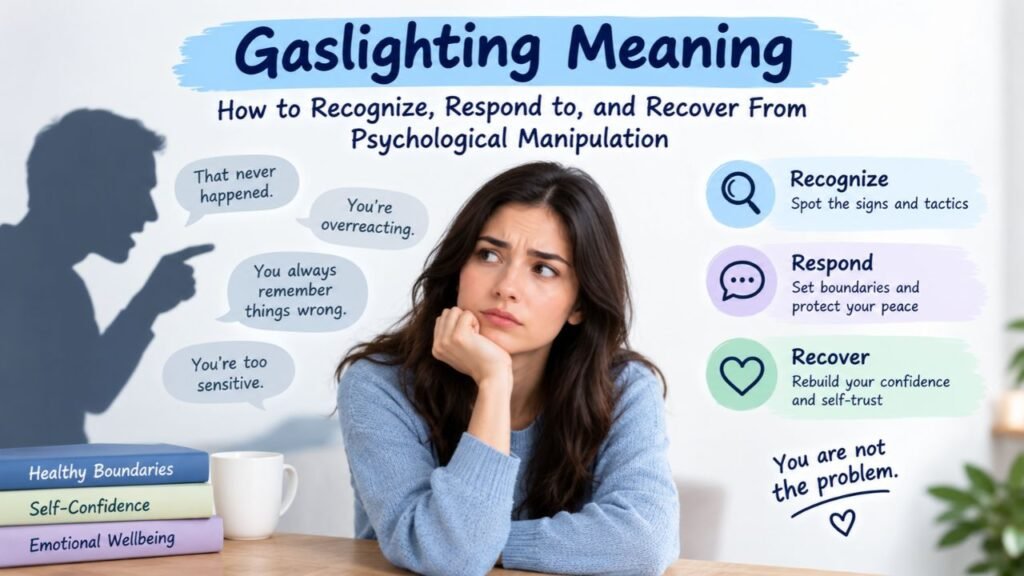





You walk away from a discussion confused. You know exactly what took place during the discussion, but the other person claims it didn’t occur. At some point, you begin to question your own recollections, intuition, and possibly even your mental state. If this occurs frequently in your life, then understanding gaslighting meaning may help you gain insight into why this is happening.
The term “gaslighting” has become ubiquitous in recent years, appearing in everything from therapy sessions to social media posts. The usage of this term can sometimes be quite loose. In addition to defining gaslighting meaning in everyday language, this guide will provide a history of how the term originated, list some of the most frequently used gaslighting tactics, and outline steps that you can take to safeguard your own mental health.
What Is Gaslighting?
The gaslighting meaning focuses on a pattern of manipulation, where a person causes someone else to question his/her perception of reality. Gaslighting is not an isolated incident or simply a disagreement; it is a series of denials, distortions, and dismissals that over time cause a person to lose confidence in him/herself.
A gaslighter may tell you they didn’t say what you know they said, say that you are being “overly sensitive”, or create a different version of events where you were at fault. Regardless of whether it is intentional or unintentional, the main reason for gaslighting is to gain control. Once you begin to lose confidence in your own ability to judge reality, you will be much more susceptible to the manipulation of others, and those manipulating you will avoid accountability.
Gaslighting is possible in a variety of settings, such as romantic relationships, family environments, social circles, workplace settings, and also interactions among organizations/institutions and people.
Where Does the Term Come From?
The term was derived from “Gas Light,” a 1938 play written by Patrick Hamilton. “Gas Light” was eventually turned into two famous movies in 1940 and 1944. In the plot of “Gas Light,” the husband tries to make his wife believe he is driving her crazy. He dims the gas lights in their home and says they are fine.
The name was first used by psychologists and authors to describe this type of mental abuse. Since then, the term “gaslighting” has become more than just a literary concept, as Merriam-Webster named it the Word of the Year for 2022 because of the large increase in people looking up the definition of the term. While greater awareness can help prevent individuals from being subjected to this form of emotional abuse, it also means that the label can be applied to common disputes. Understanding gaslighting meaning will allow you to refrain from misapplying or failing to apply the label when necessary.
Common Gaslighting Tactics
The table below provides a summary of the most common ways in which gaslighting is used as a form of manipulation. Examples of the types of statements that may be used when utilizing these strategies are also provided.
Common Gaslighting Tactics
| Tactic | What It Looks Like | Example Phrase |
| Denial | Refusing to admit something happened | “That never happened.” |
| Trivializing | Making your feelings seem small | “You’re overreacting.” |
| Countering | Questioning your memory | “You always remember things wrong.” |
| Withholding | Pretending not to understand | “I have no idea what you’re talking about.” |
| Diverting | Changing the subject | “Why are you bringing that up now?” |
| Blame shifting | Making you responsible | “I wouldn’t act like this if you weren’t so difficult.” |
| Isolation | Cutting you off from support | “Your friends don’t really care about you.” |
Individually, each tactic can appear insignificant. It’s the repeated use of them that makes gaslighting so powerful. After seeing how all these tactics are used in conjunction with one another, it will be much easier to recognize gaslighting as such in everyday situations.
Gaslighting in Different Settings
The gaslighting meaning is always the same, however the way that people engage in gaslighting will vary by location.
In romantic relationships: A partner may say that he/she did not cheat on you even though there is proof, tell you that you are “crazy” when you ask about your suspicions, or claim that he/she never promised to be faithful.
At Work: Your boss can say they did not give you instructions and then hold you responsible for what happened. Coworkers can claim credit for your ideas and tell you that you are misremembering.
In families: A parent may insist that harmful events from your childhood never occurred, leaving you to doubt your own recollections.
In friendships: A friend may continually make fun of what is important to you and then say “I’m just joking” every time you express disapproval.
Online: Public figures or groups could dispute what is factual, while portraying critics as either crazy or liars.
Also Read: TMB Meaning in Text | DND Meaning | GNG Meaning in Text
Warning Signs That You May Be Experiencing Gaslighting
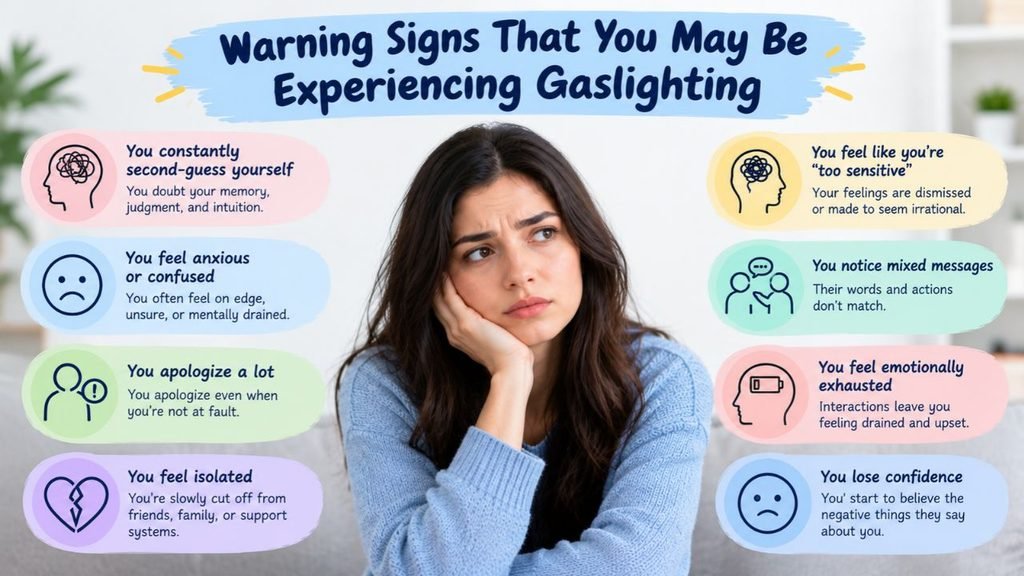
People who have a loss of confidence may not realize they are losing their confidence because the loss is gradual. Look out for the following:
- You constantly apologize, even when you are unsure what you did wrong.
- You second-guess your memory and feel the need to keep records of conversations.
- You feel anxious, confused, or “off” around a particular person.
- You make excuses for their behavior to friends and family.
- You feel you can’t do anything right.
- You withdraw from people who might offer a different perspective.
- You wonder whether you are “too sensitive” far more than you used to.
When some of the above apply to your relationship with someone, then it might be a good idea to consider the way you interact with each other. Knowing how to define “gaslighting” will help you identify the problem area without taking responsibility for it.
Gaslighting vs. Healthy Disagreement
Not all disagreements are considered gaslighting. In addition to people remembering things differently, people make honest mistakes as well. The following chart will assist you in determining the difference.
Gaslighting vs. Healthy Disagreement
| Situation | Healthy Disagreement | Gaslighting |
| Memory differences | “I remember it differently. Let’s talk it through.” | “You’re making that up.” |
| Responding to hurt feelings | Listens and acknowledges impact | Dismisses or mocks your feelings |
| Pattern over time | Occasional and resolved | Repeated, one-sided, and escalating |
| Accountability | Admits mistakes | Denies or blames you |
| Effect on you | You feel heard, even in conflict | You feel confused and doubt yourself |
| Intent | Seeks understanding | Seeks control or avoids responsibility |
You can use this comparison in conjunction with the gaslighting meaning to determine if the behavior you are experiencing is an actual pattern of manipulation, or simply a difficult time.
Is Gaslighting Always Intentional?
Sometimes. People who use gaslighting deliberately to control other people. Other people use gaslighting as a way of protecting themselves, often developed during their childhood or in previous relationships, so they can avoid having to deal with feelings of shame or conflict. While intent is important for understanding, it is not important for the effects.
No matter if the gaslighting was intentional or a habit, gaslighting meaning will always be about how much damage was done to you; i.e., your ability to determine what is real is threatened. You have a right to protect yourself regardless of whether the gaslighting was done on purpose or became a habit.
How to Respond to Gaslighting
Responding safely depends on your situation, but these strategies can help:
You have to believe in yourself. You should also remember that your emotions are real evidence, no matter who tells you they’re not.
Records are important. Keep all of your communications, including emails, and write down the date of each message. This way, if there is a problem, you will have a written record of what transpired.
Keep your composure and be precise. Report the facts without discussing whether one person is “insane.” For instance: “I recall what happened in my own manner, and I am not willing to argue with you about how you saw things.”
Create limits. Choose which actions you won’t tolerate, and how you’ll respond should those actions persist.
You need to get some outside input. Talk with people you trust – friends, family, even a therapist, they will be able to tell you how things really are.
Limit exposure. Reduce contact if possible, especially when the behavior continues after you set boundaries.
Have a safety plan in place. If gaslighting is part of an overall pattern of abuse, then make sure you are safe first, and call a professional or domestic violence hotline.
If you know “gaslighting” meaning, then you will have the language to describe your experiences to other people and therefore finding help will be easier.
The Psychological Effects
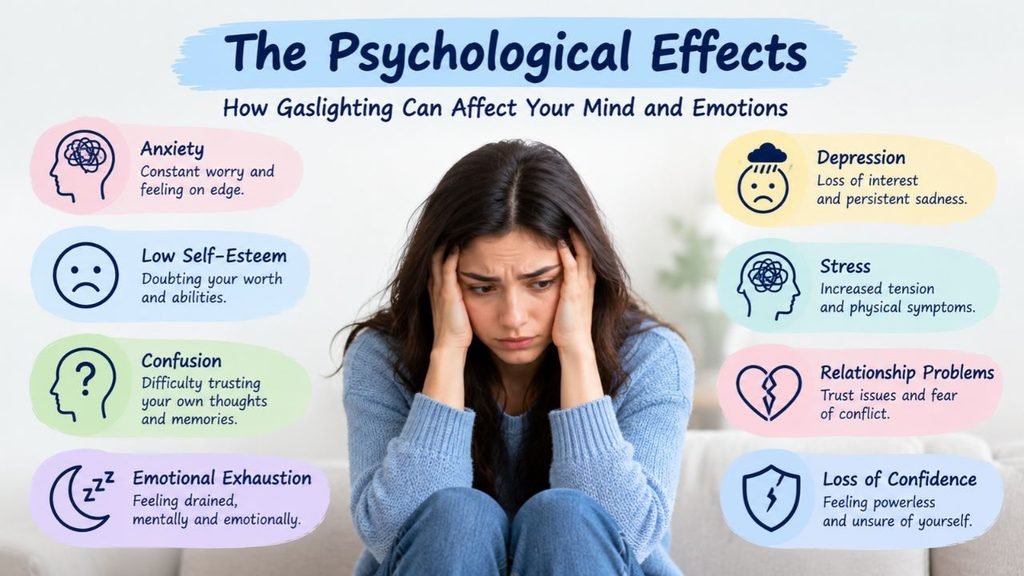
Long term effects of gaslighting include many negative mental health outcomes. Gaslighting has been linked to anxiety, depression, poor self-esteem and difficulty in decision making. People who have experienced gaslighting may also display symptoms of post traumatic stress disorder such as hyper-vigilance and sleep disturbances. Additionally, many victims of gaslighting lose contact with friends and family due to the gradual isolation of the victim by the abuser.
The effects of gaslighting do not indicate weakness. Gaslighting is effective due to the fact that it preys upon basic human characteristics such as; wanting to understand and relate to people, giving others the benefit of the doubt, and questioning oneself. To recognize the gaslighting meaning within your own experiences is not paranoia; it is a way to protect yourself.
Recovering Your Confidence
Healing is a slow process; the first step is to establish self-trust through minor daily acts like journaling, following through with promises made to oneself, and identifying when one’s gut feelings were accurate. Therapy is particularly useful because professionals can assist in untying manipulated thoughts and establishing healthier behaviors. Support groups (both in-person and virtually) provide individuals with a sense of community and the knowledge that they are not alone.
Connect with those who respect you and schedule time for things that help ground you. Eventually, the confusion will disappear. A lot of survivors have described the time when they understood gaslighting meaning as a pivotal moment, as it allowed them to use words to describe something that had been happening to them for a long time.
What If You Realize You Have Gaslighted Someone?
It’s difficult to be self-aware, yet it’s very useful. When you find yourself denying things that have happened, ignoring what you’re feeling, or changing how things occurred, stop and think about it. Tell someone you’re sorry and explain why without making excuses. Listen to the person who experienced something else and think about getting help from a counselor. Understanding the gaslighting meaning more completely will allow you to see where you do this and modify your behavior.
Also Read: 6 7 Meaning | White Heart Meaning | RD Meaning in Text
Conclusion
Gaslighting can be a quiet form of harm, and it’s more prevalent than most people think. Knowing gaslighting meaning helps you know the difference between a real dispute and being manipulated. This knowledge gives you confidence in yourself and enables you to decide which types of relationships are healthy for you. When you see the signs of gaslighting in your life, remember that you have the right to be treated with respect, to understand what is going on, and to receive help.
FAQs About Gaslighting Meaning
1. Is gaslighting a form of abuse?
Yes. Repeated gaslighting is a form of emotional or psychological abuse.
2. What are some common gaslighting phrases?
Commonly used phrases such as “That didn’t occur,” “You’re overly sensitive,” and “Your imagination is running away with you.”
3. Is gaslighting a mental illness or medical diagnosis?
No. Gaslighting is a behavioral pattern, not a clinical diagnosis.
4. Can a person who gaslights change?
Yes, provided they accept accountability for their actions, accept responsibility for the outcome of those actions, and make a commitment to modify their behavior.
5. When should I seek professional help?
If you have ongoing feelings of fear, uncertainty about yourself, unmanageable emotions, or unsafe conditions, seek help.
