




DND is one of those abbreviations that can have multiple meanings. It could refer to a legendary tabletop game (seen as DnD), a phone setting, a department of government, or even an informal text message depending on where you see it. For anyone who’s ever seen “DND” and wondered which one to use, this is the guide for you, with every common dnd meaning explained so you’ll never misread it again, no matter where it appears.
The Quick Answer
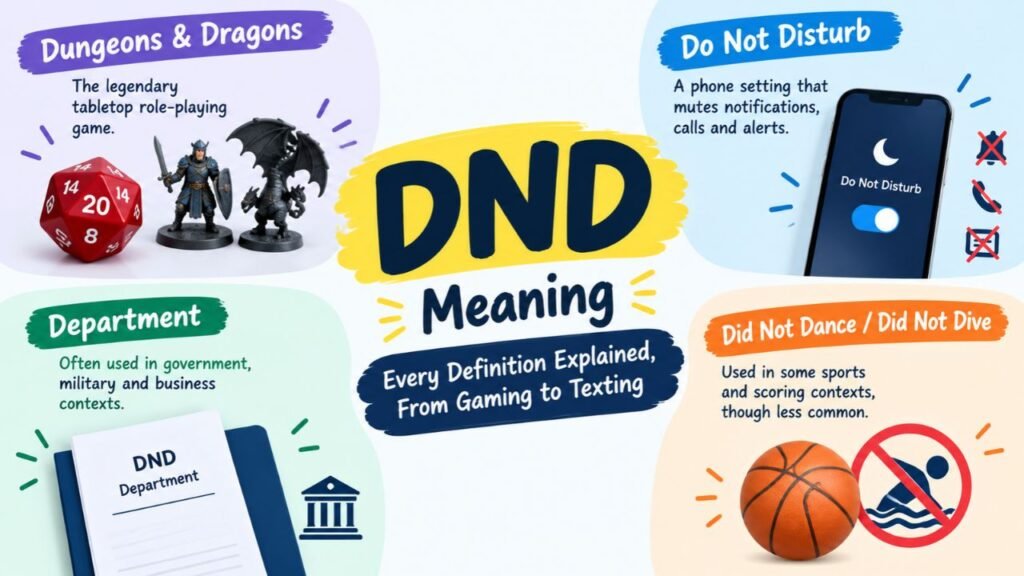
The plurality of expressions for dnd meaning is precisely why context plays such an important role in understanding. The three most common images you are trained on are :
Dungeons & Dragons – the legendary tabletop role-playing game
Do Not Disturb – a cell phone, personal device, or workplace setting
Department – Often abbreviated in government/organization contexts, like: “Dept of DND of Education
In lesser-used applications, DND can refer to “Did Not Dance” for many forms of sports, as well as organizational abbreviations specific to the country and sector one is using.
| Meaning | Full Form | Common Context |
| Game | Dungeons & Dragons | Tabletop gaming, pop culture |
| Phone Setting | Do Not Disturb | Smartphones, work communication |
| Organization | Department | Government, military, business |
| Sports | Did Not Dance / Did Not Dive | Scoring contexts, rare usage |
DND Meaning #1: Dungeons & Dragons
Gamers will always think of a dnd meaning that is most likely Dungeons & Dragons, the tabletop role-playing game originally published in 1974. Players create characters, tell stories together, and use dice to resolve actions in-game with a DM (Dungeon Master) narrating the world – including controlling non-player characters.
Dungeons & Dragons has been having a huge cultural renaissance over the last few years as much to do with that was partly thanks to things like Stranger Things and Critical Role, as well as an explosion of actual-play podcasts and streams that bring the game to a new generation of wider, more mainstream fans.
Why This DND Meaning Dominates Pop Culture
The most ubiquitous intention behind dnd meaning when someone searches is the gaming definition. Of course, it makes sense since Dungeons & Dragons has burrowed its way into modern entertainment so tenaciously, giving rise to movies, video games, merchandise, and an entire online community founded on character building, campaign storytelling, and the communal ritual of rolling dice.
Some common phrases you would see in this instance are:
- “We’re starting a new DND campaign this weekend.”
- “I just rolled a natural 20 in DND!”
- “She’s been playing DND with the same group for five years.”
DND Meaning #2 – Do Not Disturb
The dnd meaning outside of gaming circles is almost entirely different. In all smartphones, computers, and sometimes in tools like workplace messaging apps, “DND” refers to “Do Not Disturb,” a feature that mutes notifications, calls and alerts for a configurable period of time.
The constant barrage of notifications meant that this feature became a necessity. Do not disturb mode lets a person stay focused on work, sleep without disturbances, or just for the sake of spending some peaceful personal time without a phone bleeping every few moments.
Where You’ll See This DND Meaning
- “Sorry I missed your call, my phone was on DND.”
- “Put your status to DND during the meeting.”
- “I keep DND on after 10 pm, so I actually sleep.”
When someone is deep in focus, DND status indicators come into play on workplace messaging platforms like Slack and Microsoft Teams to tell coworkers that they are unreachable unless necessary.
Also Read: TMB Meaning in Text | GNG Meaning in Text | 6 7 Meaning
DND Meaning #3: Department
In formal, administrative, or governmental usage, it most often merely represents a simpler abbreviation of Department. You see this in all official documents, government websites, and organizational paperwork where space is a premium and abbreviations make things succinct.
For example, in India ‘DND’ often stands for ‘Do Not Disturb’, the telecom regulator’s registry used to block marketing calls and text messages – similarly, different letters but a related use of letters by acronym with a regulatory history. For example, DND may represent a branch of a larger organization or ministry in some other administrative scenarios.
| Context | Example Usage |
| Telecom Registry (India) | “Register your number on the DND list to stop spam calls.” |
| Government Department | “The DND released a new policy update.” |
| Military/Organizational | “Submit your request to the DND office.” |
Reason for the Confusion on the DND Meaning
This usage often appears in formal writing with little context, and can genuinely confuse readers who are new to this sense of the word, especially those more acquainted with definitions from gaming or phone settings. Contextualize! Always think of the surrounding document/conversation context type – a government notice is manifestly working under a hilariously different dnd definition than something your friend texts you.
How to Identify Which DND Meaning Is Intended
Because three-letter words range so widely, context clues are vital for quickly determining the right meaning.
Look at the setting. Remove gaming forum, Discord server or a conversation about dice and characters- and you almost definitely have Dungeons & Dragons. Look for clues that lead to Do Not Disturb, like a tech support thread or the phone settings menu. Department: Department usually refers to official papers or communication from the government.
Look at the surrounding vocabulary. The usage of the words campaign, character, dice or Dungeon Master makes it clear that it’s a gaming meaning. It is a validation of the phone-setting meaning by way of words like “notifications,” “silence,” or “status.” So, formal or bureaucratic language confirms the department meaning.
Consider who’s speaking. For example, a teenager texting about weekend plans will most likely not mean “Department”. A government press release is probably never going to mean Dungeons & Dragons. Just aligning the likely meaning in the context of the speaker with a dnd meaning resolves most ambiguities in seconds.
Other Less Common DND Meanings
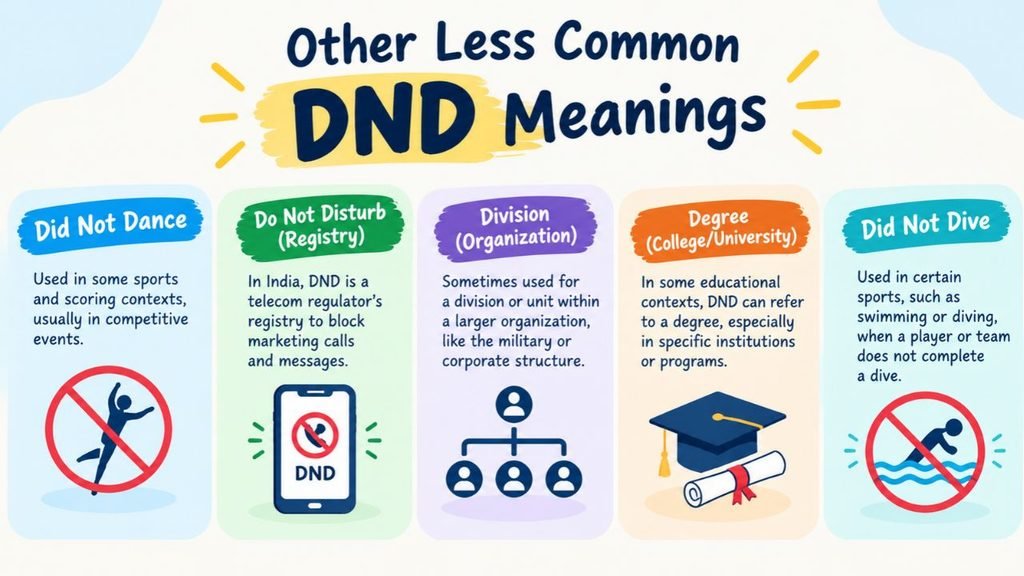
Although there are a few more niche meanings based on industry or region, the three definitions above cover most everyday use cases.
- Did Not Dive / Did Not Dance: used in scoring or competition contexts for an entrant who withdrew or did not compete.
- Dial N Dine: an older informal abbreviation for food delivery or restaurant services.
- Department of National Defence: The officially used name for defence ministry in some countries, e.g., Canada.
This uncommon interpretive aspect exposes the inherent flexibility and contextual dependence of a three-letter abbreviation which, as it crosses industries and geographies, can play very different roles.
DND Meaning in Everyday Conversation
Texting and casual chat are where both the gaming and phone-setting definitions usually combine, because day-to-day digital communication involves a lot of texting. When a friend texts you “can’t talk, DND,” they most likely aren’t communicating their Tabletop RPG references, but that they’ve enabled Do Not Disturb on their phone.
Conversely, if one posts in a Discord server for tabletop gaming: “anyone available for DND Saturday?” Clearly the gaming definition is intended, as the surrounding context of community makes the dnd meaning inarguable.
And this is actually the main point of all dnd meaning broadly: the letters themselves never tell you shit; it’s the world around them that does most of the explaining.
Understanding the Context Why This is so Important
It is for this reason that simple abbreviations like DND exist: they are efficient, short, memorable, and easy to enter. But that same efficiency, in the face of what looks very much like another ambiguous set of letters as two wholly different communities were getting mushy about each other, has lead to this situation. No one’s in cahoots here: gamers, smartphone users and government bodies all arrived at the same three letters for the sake of convenience.
This overlapping abbreviation is not a flaw, but rather a relatively common phenomenon across languages. Acronyms are abundant that carry more than one equally valid meaning, and it just becomes an exercise in context rather than looking for a single universal definition.
Also Read: RD Meaning in Text | WYO Meaning Slang | PMO Meaning in Text
Conclusion
So what does dnd really mean? I mean, it honestly all depends on where you hit it. For gamers, it is Dungeons & Dragons-a classic tabletop roleplaying experience that has recently enjoyed a renaissance in popularity. For mobile users, it’s Do Not Disturb, a basic yet necessary notification-muting utility. In terms of government and organizational contexts, it primarily translates to Department, just simply the department.
You will never be caught by surprise in this neat little abbreviation, provided you have a grasp of these three basic interpretations and a few rarer regional typologies. Context is indeed everything when it comes to determining which dnd, exactly, applies in any given context.
Frequently Asked Questions
1. What does DND most frequently stand for?
The most common definition of DND is Dungeons & Dragons, and the second most common is Do Not Disturb (Phone & Tech)
2. Is DND always Dungeons & Dragons?
No. Depending on context, it can also mean Do Not Disturb, Department, etc.
3. What does DND means in mobile phone?
In the context of smartphones, DND is Do Not Disturb – a state that mutes calls, text messages, and notifications.
4. What is the meaning of DND registry in telecom?
The DND registry allows the public to register their mobile number and then avoid unwanted telemarketing calls or messages.
5. How do you decide which dnd meaning someone means?
By the context: gaming means D&D, tech denotes Do Not Disturb, formal writing as a Department.
